Life In The Outdoors
February 3, 2016
Fishing Tournament Success: Solving the Practice Equation
With Jon Lawson
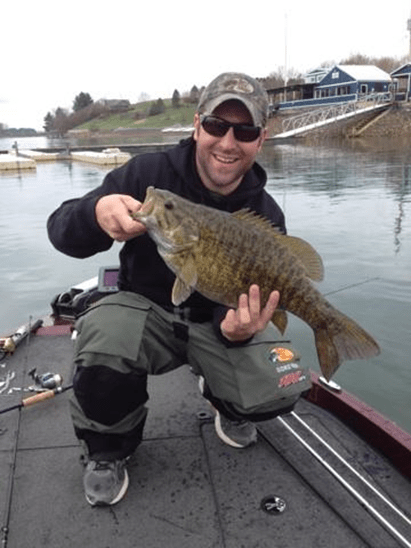
The author with his fish of a lifetime from 2015 (caught during a pre-fishing trip).
The beginning of the year is a sacred time for most tournament bass anglers. Regardless of the competition level, touring professionals and weekend bass club warriors alike are full of anticipation and dreams of tournament wins and angler of the year championships in the upcoming season. The entire off-season has been busy, filled with tournament schedule releases, calendar updates, map study, and tackle organization. Anglers find unending ways to stave off cabin fever by tinkering in the garage or making a few more clicks on your favorite outdoor websites. The question arises, however, what exactly separates the top of the field from the bottom? The answer seems to be decision making and time management, especially when it comes to scouting trips or ‘pre-fishing’.
It is often quoted that “A bad day fishing is better than a good day at work.” But, what can a bad day fishing teach us? When scouting a lake for the first time or looking for new spots on your home lake, the needle in the haystack approach can sometimes be overwhelming. Luckily, technological advancements have come about to make your time on the water more productive and give you a chance to see and even replay each day fishing in an entirely different spectrum.
Film Study
Ask any NFL quarterback after a playoff victory and the secret to success is usually the same, film study during the week had them prepared for anything the defense could throw at them. Even on the high school level, athletes use film study to break down every aspect of an opponent while learning from their own mistakes and successes. Tournament pre-fishing can now be the same for anglers, sports cameras like the ION Air Pro Lite Wi-Fi can capture all of your own highlights from the water in full 1080P HD clarity. Without breaking the bank, you can have detailed video records of every catch, every cast, every condition you find on the water while preparing for your next derby.
On Good Friday, April 3, 2015, I was fortunate enough to capture a fishing moment of a lifetime with my ION camera. Fishing on South Holston Lake in Virginia, I was able to hook and land a potential state-record smallmouth bass weighing over 8 pounds. The entire battle was recorded on my camera, making the decision easier for me to simply catch, weigh, and immediately release the majestic fish without having to harvest it for proof. That giant bass is still swimming in South Holston, mostly due to fact that I knew I had the video evidence. Uploaded on YouTube (see it here https://youtu.be/9LYF7EJpGak ), it has already gathered over 6,000 views and helped garner some positive attention for one of our local lakes.
Sharing your successes is also easier than ever. Thanks to these sports cameras, uploading to YouTube is a snap, plus making your own website with high-quality video to promote yourself and your equipment has never been easier. The video element can elevate your fishing game to a whole new level – just click record and go fishing then relive every moment on your TV or computer later.
The HDS Insight Advantage
The next tech advancement that can turn your practice time into quality time comes from the depthfinders and GPS charts found on today’s electronics. The Navionics SonarChart maps allow anglers access to real-time maps using information from recorded sonar logs. Custom bathometric (underwater topo) maps can be created from GPS routes so you can hone in on the sweet spot every time. The possibilities are endless and can give you up-to-the-minute information that is only available to you during your tournament.
B.A.S.S. pro and Skeeter Boat pro Mark Menendez of Paducah, KY offers the following about the Navionics capabilities, “whenever I am out on the water pre-fishing for an Elite Series event, I want to be in tune with the areas I’m fishing, Navionics SonarChart has changed the game by giving me tons of real-time information on the water. Also simply loading my custom maps on a SD card allows me to review them in the nights leading up to a tournament and find things I may had overlooked while I was fishing. I like to know the bottom composition of the areas I’m fishing, looking for hard bottoms or mussel beds instead of silted in areas, with today’s electronics I now have high-resolution sonar that allows me to find fishing spots that other anglers may had missed.”
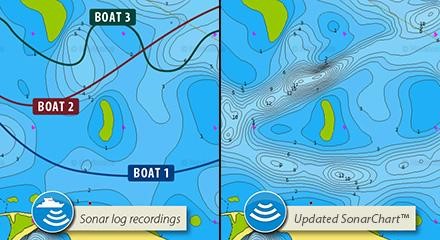
Example of Navionics SonarChart updated mapping.
The combination of film study and personalized map making will nearly guarantee your success on the water in the upcoming year. See you on the water!
Life In The Outdoors

February 11, 2015
Hookin’ Up: The Art & Science of the Hookset
With Jon Lawson
In every episode of Bill Dance, Roland Martin, and Jimmy Houston’s fishing shows that young anglers watched on The Nashville Network years ago was loaded with strong, boat-rocking hooksets. One after another, the hook-burying whiplash of the rod brought numerous five-pound bass to the net and became engrained in the minds of so many hopeful anglers. The forefathers of professional fishing were selling the steak by showing the sizzle. A lot has changed since the days of the Saturday morning outdoor programming block on TNN, but the idea of bone-jarring hooksets has remained.
It comes as a surprise to some anglers today that with improvements in fishing line and super sensitive rods that the herculean hookset sometimes can cause nightmares, like poorly hooked or even lost fish. When stretchy monofilament line and flipping sticks resembling broom handles were the norm, a lot of force was needed to pull the hook through the fish’s lip. Today, braided and fluorocarbon line offer low or zero-stretch options that connect the angler and his quarry like never before.
Rod makers, like American-made Kistler Rods (www.kistlerrods.com), have joined the revolution by manufacturing rods with next generation materials and actions to match any presentation imaginable. Microguides and high-modulus graphite give anglers more sensitivity, while actions from medium-light to extra heavy are fine-tuned to allow anglers the power and control to bring hooked fish to the boat.
“Tightlining is my favorite winter technique, using 4-pound test and tied to an 1/8th ounce jighead with a Berkeley GULP! Minnow attached,” stated Nathan Light of the 3Boutdoors television show, “a hookset with this light line is not possible without proper equipment, I use a 7-foot Kistler Helium LTA medium action spinning rod or the new line of Magnesium spinning rods for the sensitivity to feel the bite and the fast tip to set the hook without breaking the line.”
A powerful hookset is still needed for lures like jigs and bulky soft
plastics when fishing in heavy cover. However, with today’s low stretch lines a change in rod action may be needed to absorb some of the shock. Furthermore, finesse techniques like shaky heads and drop shots now utilize light wire hooks that do not require anything more than reeling and a steady lift of the rod to penetrate the fish’s mouth.
The golden era of bass angling is upon us. Shallow or deep, the possibilities are endless and patterning fish is more important than ever. Anglers are offered so many great options on gear and techniques to catch fish, a little attention to detail can allow you to set the hook properly and help you bring home the fish of a lifetime.

January 19, 2015
Cooler Weather Should Have You Chasing Does Too
With Jon Lawson
Have you had a successful hunting season? If not, don’t worry. Your best chance at a big buck this year is at hand. The whitetails have started to get accustomed to every Tom, Dick, and Harry that has hit the woods in the last month. They are getting used to the human odor a little by now. Still, the big bucks could care less if you are there or not. They’ve got that look in their eyes again, a swelling of their necks, and a smile on their face like they are in an Enzyte commercial. Throughout Southwest Virginia and East Tennessee the rut is on.
The shorter daylight periods have really turned their attention to the opposite sex. This is good news for late season hunters and if you have stored the camo for the season you might want to rethink it. The patterning you worked on all off-season is now out the window and hunting near food sources can put you in a bind since bucks are too busy chasing and won’t visit them to late in the day. All bets are off, but if you caught yourself complaining about seeing too many does earlier in the year, now those does are your greatest allies. All of the does in a particular area usually come into estrous at about the same time. So you need to find the does and let them help draw the big boys to you.
Buck scrapes should be hot now and rubs are plentiful. Keep an eye out for these as clues as to where you should set up. The weather is going to cool over the next couple of weeks so wrap up tight, don’t forget your buck lures, and get ready for some action. Deer movement will peak before any severe cold front this time of year especially if the food supplies are limited in the area.
If you think back to what the woods looked like in the early season, with the leaves still dense on the trees and many plants fighting off dormancy, and now look at what we see, dormant grasses and bare trees. Deer now have little choice on where to go for safety. If you are hunting a highly pressured area make note of where the thickets and dense evergreen stands are located. Often during the late season these areas are the only cover available for deer to retreat to if they are threatened. They will make their way there to bed down also.
When hunting the rut don’t let yourself think that just because you haven’t seen much activity that the rut is over. Does that are not bred will come into a second or even third estrous. The rut and late rut can span over 3 or more weeks. Another bonus is for the bowhunters out there. Just because you can bring your firearm or muzzleloader to the woods isn’t enough reason to leave your bow at home. You actually have a better shot at tagging a big buck with a bow during the late season and I promise it will feel just as good as it would had back in November..
January 16, 2015
Weather Patterns and Fishing Patterns
With Jon Lawson
Ben Franklin was quoted to say “some men are weather-wise, but most men are other-wise.” That saying can ring true with anglers throughout our area as well. For example, rising or falling barometric pressure is widely known as a factor in a fish’s mood but most do not fully understand it. On the flip side, all anglers have dealt with the dreaded spring cold fronts that give the fish lock-jaw. An in-depth look at weather patterns and fish behavior should help you select the best presentations for the given conditions next time you are on the water.
The effects of cold fronts
Everyone has seen the fishing forecasts on your calendar that predict feeding times and classify specific days as “poor”, “fair”, “good”, or “excellent” days to catch fish. These are based on solunar calendars, using the sun and moon phases to predict not just fish, but all wildlife activities. There are plenty of “farmer’s almanac fishermen” out there that swear by these forecasts, but there is something missing from this prediction model: the weather!! Truth be told, the solunar tables are based on steady, fair weather. Everyone that fishes regularly knows that days with steady, fair weather are few, especially during the springtime. Dropping barometric pressure signals the beginning of a frontal disturbance, meaning clouds and often precipitation. Conditions like that, coupled with a chilly northern wind, can wreak havoc on even the best pattern. Bass activity will be hot and heavy before the front hits but soon thereafter your honeyhole transforms into Lockjaw Lake. It’s not lockjaw however, fish activity does slow during cold fronts but they can still be caught. Actually, fish movement during fronts causes more headaches than their loss of appetite. Often the fish will hang around the same area but retreat to deeper water nearby. Deeper water and a smaller strike zone cause anglers to come back to the house talking about the one that got away (or the one that didn’t bite at all). Backing off the bank to the first drop off and fishing slow, deliberate presentations can turn a slow day into a memorable one. Sometimes all it takes is tying on deeper diving crankbait and combing through structure, other times the fish will bury deep in cover and it will take finesse presentations to draw them out.
A rising barometer is often coupled with high blue skies. This can also make fishing tough because there are no clouds or wind to camouflage your presence to the bass. Bass are very visual and can spook easily with boat traffic and angling pressure. Also, the high blue skies pushes baitfish towards lower depth zones and to catch fish may have to venture from the banks to drop-offs and humps to locate the predators. Keep your mind open during cold fronts to transform from a zero to a hero.
Wind positions your fish
Changing weather doesn’t always mean poor fishing. Mother Nature can actually help you in your search for fish. If the wind is blowing you need to take advantage of it. Steady wind can create mini-currents on our area lakes. These currents begin moving the plankton around in the water column and the baitfish follow these movements to feed on the microscopic organisms. The wind will blow the plankton toward points and bluffs and the baitfish will take advantage of the concentrations of food. Bass and other gamefish will then move in to position to ambush the feeding shad and other baitfish. Follow the wind to find good concentrations of both bait and big bass!
The wind will also make the fish less skittish. The chop on the water breaks up light on the surface creating better conditions to find fish that will bite. Wind creates conditions similar to the low-light periods at dawn and dusk when fish are historically most active. A windy day can make for some great fishing in East Tennessee but a word to the wise, be sure you have a strong trolling motor and fully charged batteries before you decide to fight the wind all day.
In conclusion, realize that anglers have caught them in the rain and they have caught them in the snow but to make the most of your fishing time, make sure you check the weather days in advance of your next fishing excursion. Use that knowledge to your advantage and you will make the most of your time on the water.
 Wild Game Expo